
Salisbury One-Person Record Paths
Treat a Salisbury resident lookup as a series of narrow confirmations. Do not treat it as one search box. Maryland offers no unrestricted current-address search by name. The Maryland Department of Assessments and Taxation, known as SDAT, starts from an address. It also accepts a property account number or a map reference. Maryland Judiciary Case Search starts from a party or case query. The voter service demands a full identity-and-address combination. Label each result for what it truly proves. An assessment owner, a recorded party, and a current occupant differ. They can easily be three different people.
| Record | What it can confirm | Custodian | Access route |
|---|---|---|---|
| SDAT parcel card | Recorded owner, situs, tax-mailing address, sale and deed references | Maryland SDAT | Free address, PAN, or map search |
| Recorded deed | Grantor or grantee role, recording date, legal description, book and page | Maryland Land Records | Account search, Clerk counter, or Archives |
| Court summary | Party role, case number, filing date, status, and disposition | Maryland Judiciary Case Search | Online summary; complete file at Clerk |
| Voter service | Registration service details for the person using the lookup | State Board of Elections | Required identity and address fields |
| Estate or vital record | Estate roles or an event record where access is allowed | Register of Wills and MDH | Search, custodian request, or historical archive |
Let the known fact pick the starting source. A street address points to SDAT and then the deed index. A case number points to CaseSearch and the Wicomico Clerk. A known date plus a qualifying relationship can open a vital-record request. Two independent records that agree are worth far more than one alone.
Note: An online result is a research lead only. Keep its date and go back to the named custodian for a complete or certified record when it matters.
CaseSearch Details for Salisbury Residents
CaseSearch covers Wicomico Circuit and District Court summaries, with local dates and limits worth knowing. Automated coverage starts October 14, 1997 for Wicomico Circuit civil matters. Circuit criminal coverage begins August 7, 2000. District civil coverage reaches back to 1989, and District criminal coverage to late 1991. Anything older, closed, or excluded by court rules needs a different route. The Wicomico Clerk records page names the local file custodian. The office sits at 101 North Division Street, Room 105.
| CaseSearch field | Salisbury use |
|---|---|
| Last name | Exact by default; a partial requires the first character followed by %. |
| First and middle name | Use registered spelling, initials, and known variants to reduce a same-name result. |
| Court and case type | Choose Wicomico and a relevant division or category when the name is common. |
| Filing-date range | Pair it with a name and keep the range narrow. |
| Case number | Use the full number when available; newer portal formatting can omit dashes. |
Large searches get capped at 500 results. Narrow with a first name, court, case type, or date range. Do not assume the person is absent. A result may show city and state. It may also show date of birth where public, attorney, related parties, docket events, and disposition. Remember it is a case summary. It is not an official ruling on identity. Sealed, juvenile, adoption, and certain health material never appears as a public web result. Financial, shielded, and expunged records are excluded too. Contact the Clerk for the full underlying file. You can also use the Wicomico judicial-record request channel.
Salisbury Voter Lookup Requirements
The Maryland voter service is a precise confirmation tool. It is not a public roster. The form asks for first name, last name, full date of birth, and street number. It also asks for a five-digit Maryland ZIP code. A middle initial stays optional. Updates run daily. Even so, a new registration can lag. Online or MVA changes may take up to three weeks to show. A failed search can simply mean a registered nickname. It can also mean a former ZIP, a former name, a recent move, or a confidential registration. The State Board voter search page shows why every required field matters. Its result helps a person review registration, find a polling place and districts, or request a duplicate card. It can also check ballot-status details or locate the local board. It cannot browse everyone in a ZIP or at one address.
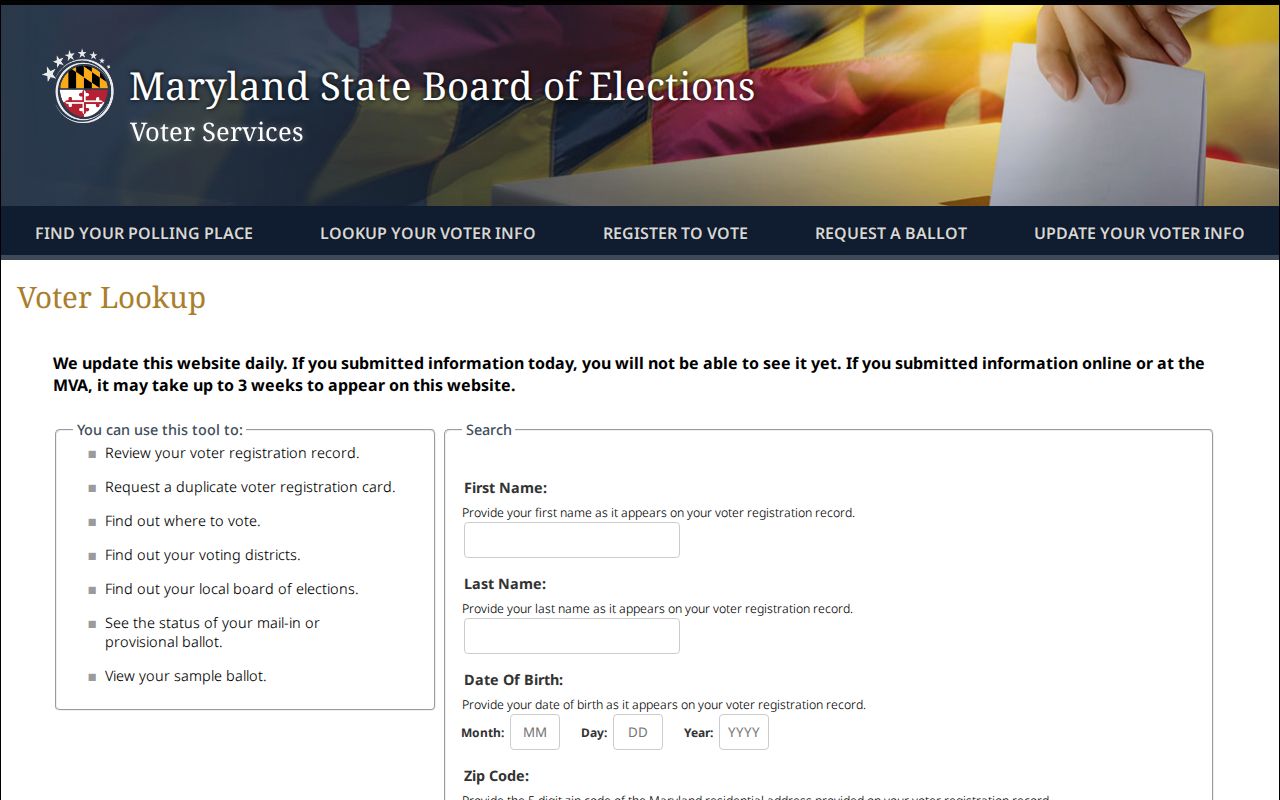
Treat the result as one corroborating record, nothing more. Most registration information is open to inspection, but confidential items are protected and voter data may never be used for commercial solicitation. Questions about inspection, list procedures, redaction, and current use rules go to the Wicomico Board of Elections at 345 Snow Hill Road in Salisbury. That human channel settles what the online form cannot.
Confirming a Salisbury Resident
When a name appears in more than one record, follow a repeatable sequence. Normalize names first. Record the maiden name, nickname, middle initial, and suffix. Add hyphenation and likely misspellings too. This beats forcing every hit into a single profile. Next, tie the name to a property or a case. Then weigh an independent item that has its own custodian. A name match with no address, date, court, parcel, or estate number behind it is weak evidence on its own.
- Search CaseSearch with the exact name, then use a narrow
%search only if needed. Save the party role, court, case number, filing date, city or state, and disposition. - When an address is known, use SDAT's address, PAN, or map method. Separate the premises address from the address used for assessment mail.
- Use the deed liber and folio from SDAT in Maryland Land Records. Confirm the legal description and recorded party role, not merely the shared name.
- Use the voter service only with all required fields, or use probate, archival, business, or vital routes for the specific question.
- Docket
- A court's running list of filings, hearings, and case events.
- Index and image
- An index helps locate a record; an image is the scanned document or page itself. One may exist without the other.
- Certified copy
- A copy issued and authenticated by its custodian for a purpose that requires official certification.
SDAT will not start from an owner name. A parcel result displays the indexed owner, though. That Salisbury-specific constraint shapes every search. A one-person lookup usually needs a known address, PAN, court record, or deed reference. Property evidence can help only after that. To build a wider address chain, turn to the Salisbury Street Directory once the person and the location are clearly distinguished.
Vital and Estate Resident Paths
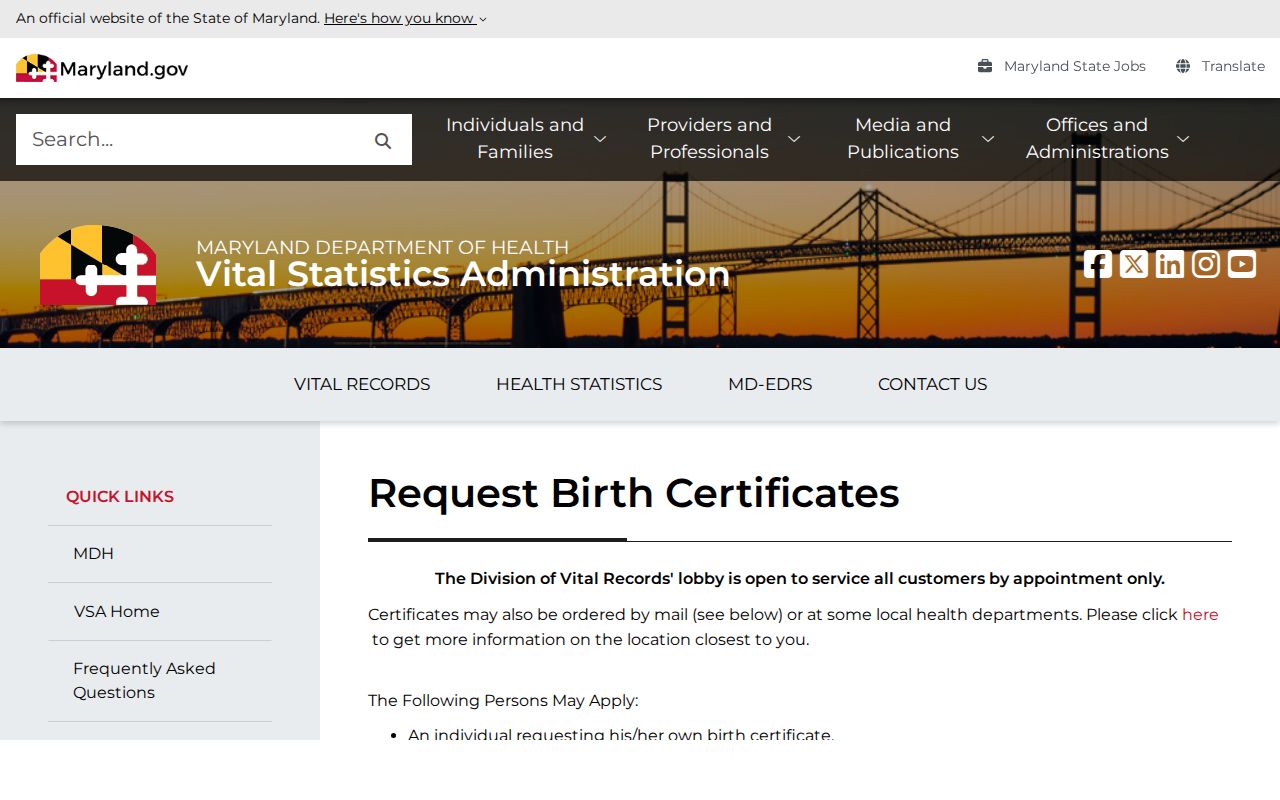
Maryland keeps its vital records under strict custody rules. The Division of Vital Records controls birth certificates. It also holds death certificates for 2012 and later, and marriage certificates dating from January 1, 2007 forward. Access to a birth certificate is limited to specific people. That includes the person named on the record and a parent listed there. A court-appointed guardian, a surviving spouse, or an authorized representative carrying notarized permission also qualifies. Certain court and adoption applicants qualify too. Birth records more than 100 years old leave the division. They pass to the Maryland State Archives.
The Maryland birth-record request page lays out several ways to apply. You can go online, by mail, by appointment, or through some local health departments. Walk-in service is not offered. The lobby serves visitors by appointment only. Mail requests must reach the Division of Vital Records with the completed application, payment, identification material, and a self-addressed envelope. No processing time is stated on that page. A $10 fee applies to birth copies. The tight eligibility rules mean a certificate is nothing like a public directory entry.
Heir research starts with the Wicomico Register of Wills Estate Search. The search accepts a last name and a county. A wildcard % helps, and so does a date range. Queries returning more than 500 results demand narrower terms. Published notices only scratch the surface. Room 102 holds the fuller estate files. Staff will respond to requests made in person or in writing, though filings by email are not accepted.
Older records follow different custodians. Deaths before 2012 and historical births belong with the Archives. Marriage copies predating 2007 go to the circuit court where the event occurred or to the Archives. Current death and marriage applications carry their own entitlement rules and request channels. For any restricted record, use the custodian's official form rather than expecting a public name index. None is published for that purpose.
Human Paths Through Salisbury Archives
Some questions are better answered in a reading room than in a live portal. A former classmate, a deceased relative, or a family-history puzzle often leaves traces in print. The Vicki Greene Maryland History Room at Wicomico Public Libraries holds old directories, family genealogies, church histories, Daily Times indexes, maps, military and pension material, and local land records. Its downtown branch is the Paul S. Sarbanes Library. The collection description notes that these materials do not circulate. So a call to the reference desk makes sense before any specialized visit.
The Nabb Research Center serves as the official archival repository for City of Salisbury material. Its holdings date from 1867 onward. On site, researchers find yearbooks, newspapers, family material, maps, microfilm, and records of local organizations. Its Enduring Connections project is searchable. It pulls together censuses, certificates of freedom, church records, ledgers, newspapers, and oral histories for Delmarva Black-history research. These human sources can preserve a relationship or a place. No modern online index captures them.
Business ties open a third path. Maryland Business Express searches by business name, Department ID, or EIN. It may return a resident agent, principal office, status, and amendments. Maryland Labor's profession query is another credential source, tied to specific dates. Neither one proves that a person currently lives at a displayed address.
Salisbury PIA Record Requests
When a record is not online, ask the right custodian for the existing record series. Maryland's Public Information Act, Md. Code, General Provisions §§4-101 through 4-601, generally grants inspection rights subject to exceptions. Timing matters here. Under GP §4-203, a custodian must grant or deny promptly and within 30 days. Production sometimes takes more than ten working days. In that case, an estimate must be provided. Attorney General guidance adds that the first two hours of search time are free. Reasonable search, preparation, and copying charges are allowed after that.
Wicomico accepts written requests by letter, email, or its own PIA form. The City of Salisbury runs a separate public-records request portal. A good request states the name, the address or parcel if known, and the record series. It should also give the date range. Ask for the segregable public portions and a fee estimate. Keep two limits in mind. A request cannot force an office to build a new resident list. It also cannot override vital, voter, court, juvenile, or other confidentiality rules.
Privacy Limits for Salisbury Lookups
Some records are closed for good reason. Maryland Safe at Home can shield a qualifying participant's address, and election confidentiality procedures can protect residential address, email, telephone, candidacy, and campaign contact details in qualifying safety or serious-privacy situations. A missing entry proves nothing. Absence from the voter service does not mean someone never registered. Sealing, shielding, expungement, and other record-specific restrictions each run through their own procedures. Anyone who spots an error should contact the court, SDAT, elections office, or other source custodian, since a result copied elsewhere can never correct the original file.
Commercial people-finders carry their own hazards. They can merge same-name records. They can hold onto old addresses. They can repeat data that was never corrected. Official records have limits too. Their dates, custody, and correction paths can at least be identified. Confirm any conclusion with the office holding the record. Keep a lead, an index entry, and a complete document clearly apart.